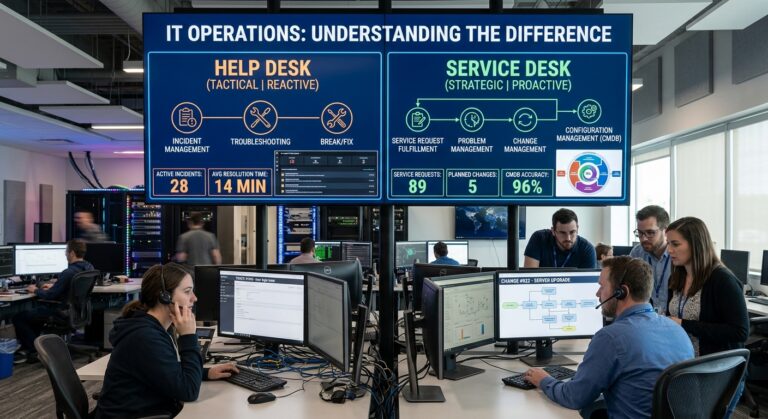
A network engineer analyzes IPv4 and IPv6 traffic while reviewing the transition to modern IPv6 network infrastructure.
Every week, someone asks me to settle the IPv4 vs IPv6 debate, and my answer usually starts with a story. A few years ago, a client called me with a complaint that sounded simple. Their new client portal loaded perfectly in the office, but half their customers said it timed out on their phones. Naturally, the developers swore nothing was wrong, and the hosting company said the server was healthy. So I spent an afternoon on it, and once I knew where to look, I found the culprit in about ten minutes. Someone had published an IPv6 record in DNS pointing to an address the server was not actually listening on. As a result, office users on an IPv4 connection never noticed anything. Mobile users, however, whose carriers had already moved to IPv6, hit a dead end every time.
That ticket stuck with me because it captured the whole IPv4 vs IPv6 situation in miniature. Most businesses still think of IPv6 as something for the future. Meanwhile, a large share of their own customers are already living on it.
So let me walk through the IPv4 vs IPv6 question the way I would with a client who has thirty minutes and a healthy dose of skepticism. First, what is different. Then, why the old protocol ran short and what that shortage costs right now. Finally, why a transition that started in the 1990s is still not finished.
IPv4 vs IPv6: Two Protocols, One Job
Strip away the jargon, and an IP address does one thing: it tells the network where a packet should go and where the reply should come back to. In other words, every router along the path reads that address and decides which direction to send the packet next. Without it, nothing on the internet finds anything. That shared purpose is the starting point for any honest IPv4 vs IPv6 comparison.
IPv4 arrived in 1981, written for a modest research network of universities and defense labs. Its designers therefore gave it room for roughly 4.3 billion addresses, which must have felt absurdly generous at a time when computers filled rooms and cost as much as houses. After all, nobody in that room was picturing a world where a single family owns a dozen connected devices, or where a factory floor might have thousands of sensors, each wanting its own address.
Consequently, IPv6 was designed in the mid 1990s once it became obvious the math would not hold. It does the same job as its predecessor. Still, it does that job at a scale that will not run out in our lifetimes, or anyone else’s.
IPv4 vs IPv6, Feature by Feature
When I teach the IPv4 vs IPv6 differences to newer engineers, I avoid starting with the giant address numbers. Although those numbers are impressive, they are abstract. Instead, the more useful picture is how the two protocols behave differently in daily operation.
IPv4 vs IPv6 Addressing and Notation
IPv4 addresses are 32 bits, whereas IPv6 addresses are 128 bits. That jump does not just give us four times as many addresses; in fact, it gives us roughly 340 undecillion of them. In practical terms, a typical small business connection can receive more IPv6 addresses than exist in all of IPv4 combined. As a result, the scarcity mindset simply goes away.
The notation changes too. IPv4 is the familiar four numbers with dots, such as 203.0.113.45. By contrast, IPv6 is written as eight groups of hexadecimal characters separated by colons, such as 2001:db8:acad:10::1, with runs of zeros shortened to a double colon. The first week, admittedly, everyone hates it. By the second month, however, most technicians stop noticing.
Headers and Fragmentation in IPv4 and IPv6
The IPv4 header ranges from 20 to 60 bytes and includes a checksum that every router must recompute as the packet travels. IPv6, on the other hand, settles on a fixed 40 byte header, drops that checksum, and pushes optional features into extension headers that most routers never need to examine. Because there are fewer decisions per packet, forwarding becomes more predictable.
Similarly, the rules for breaking packets apart changed. In IPv4, any router along the way can fragment a packet that is too large for the next link. IPv6, however, leaves fragmentation only to the original sender. Routers simply drop the oversized packet and send a message back asking for a smaller size. It is a cleaner design; nevertheless, overzealous firewall rules that block those messages can make connections hang in confusing ways.
Configuration, Discovery, and NAT
IPv4 leans heavily on DHCP. IPv6 supports DHCP too, but it also lets devices configure themselves using information routers advertise on the network. On a large campus or warehouse network, for example, that can save a lot of manual work.
Likewise, local discovery works differently. IPv4 relies on ARP and broadcast messages, which every device on a segment has to listen to. IPv6, by comparison, has no broadcast at all. Instead, it uses Neighbor Discovery and multicast, which reaches only the devices that need to hear it.
Finally, there is translation. IPv4 survived its shortage by hiding entire networks behind a single public address using NAT. IPv6, meanwhile, was built so every device can hold a globally unique address again. That returns the internet to how it was originally meant to work, and it also puts the responsibility for access control squarely on the firewall, where it belongs.
How We Ran Out of IPv4 Addresses
The supply chain for addresses works a bit like wholesale and retail. IANA sits at the top and hands large blocks to five Regional Internet Registries. Those registries, in turn, allocate space to providers and organizations in their part of the world.
IANA gave away its last unallocated blocks in early 2011. Then the regions followed, one by one. Asia Pacific hit the wall first because its internet growth was the steepest, and Europe came next. North America lasted a few more years, until ARIN reached depletion of its general IPv4 free pool on 24 September 2015.
Even so, plenty of people misunderstood what that meant. Nothing went dark, and existing addresses kept working exactly as before. What changed, rather, was how you get new ones. Since depletion, organizations in North America have had three routes: join a waiting list, qualify for a small reserved pool meant for special cases, or buy space on the transfer market.
Unfortunately, the waiting list is not a realistic option for anyone on a deadline. ARIN’s data showed the oldest active request had been sitting since March 20, 2025, which put the front of the line at about 388 days as of April 2026, with 523 requests still unmet. So if you are a growing provider or a company launching new infrastructure, a queue measured in years is not procurement. It is hope.
The Real Cost of IPv4 vs IPv6 for Businesses
Scarcity eventually shows up on an invoice, and that is usually when executives start paying attention to IPv4 vs IPv6.
The Secondary Market
IPv4 addresses now change hands on a secondary market, much like real estate or used equipment. Prices spiked during the pandemic boom and have since settled. For instance, CircleID’s review of first half 2026 deals placed the average at $20.04 per address, about a third of the late 2021 peak. That sounds cheap at first. However, addresses are generally sold in blocks of at least 256, because smaller blocks are not widely accepted for routing on the public internet. Very quickly, then, you are spending thousands of dollars on something your business never used to think about.
Alternatively, companies that do not want to buy can lease. August 2026 marketplace data showed lease bands of roughly $0.30 to $0.50 per IP per month, depending on block size. Of course, that is a recurring cost with no end date.
The Cloud Meter
The cloud, moreover, made the shift impossible to ignore. Starting February 1, 2024, AWS began charging $0.005 per IP per hour for every public IPv4 address, attached or idle. That comes to about $3.65 a month or $43.80 a year per address. Meanwhile, IPv6 addresses carry no charge at all.
I have audited cloud accounts for small firms where that line item had quietly tripled over a year. Notably, nobody had done anything wrong. A load balancer here, a test server left running there, plus a couple of reserved addresses someone forgot to release. Individually, each was small; together, they formed a steady drain. In almost every case, though, a sensible IPv6 plan would have cut a meaningful slice of it.
The lesson I give clients about IPv4 vs IPv6 costs is therefore simple. IPv4 has turned into rented property, whereas IPv6 is the free land right next door.
IPv4 vs IPv6 Adoption: The Halfway Mark
Here is the encouraging part: the IPv4 vs IPv6 transition is real, measurable, and accelerating.
Google has published IPv6 usage data for nearly two decades, and in 2026 the line finally crossed the midpoint. Specifically, the Internet Society reported that native IPv6 access to Google passed 50% for the first time, reaching 50.10% on 28 March 2026. Similarly, APNIC described the same moment as roughly half of Google’s users now arriving over IPv6.
Averages hide a lot, though. Countries vary enormously, from France at 73%, India at 72%, and Saudi Arabia at 65% down to Italy at 17%, Spain at 10%, and Egypt at 4%. In general, the leaders share one trait: large mobile or broadband providers that decided early that buying IPv4 for every subscriber was not sustainable.
The weak spot, meanwhile, is on the server side. In short, users have moved faster than the services they connect to. A 2026 scan of the top million domains, for example, found only slightly more than a third were IPv6 enabled. That imbalance is exactly why my client’s portal problem happened in the first place. Their customers were already on IPv6, while their infrastructure was only pretending to be.
What Is Holding Back the IPv4 vs IPv6 Transition
The question I get asked most is some version of “If IPv6 is better and free, why haven’t we all finished?” After years of doing these projects, my list of reasons for the slow IPv4 vs IPv6 shift has not changed much.
Technical Friction
To begin with, NAT worked too well. Translation was meant to buy a few years; instead, it bought decades. Internet providers then stacked Carrier Grade NAT on top of it, sharing one public address among many customers. It is clumsy, and it complicates logging and some applications. Yet users rarely notice, and when users do not notice a problem, budgets rarely follow.
In addition, running both protocols means two of everything. The normal path is to run them side by side, known as dual stack. That means maintaining parallel firewall rules, routing, monitoring, and documentation. For a small business IT team of two or three people, consequently, that extra load is genuine.
Old gear is another obstacle. Phone systems, building management controllers, aging firewalls, and custom business applications often have weak or missing IPv6 support. Understandably, replacing equipment that still functions is a tough conversation.
Human and Budget Friction
Furthermore, nobody feels IPv6. Faster internet is noticeable, and so is a new laptop. A successful IPv6 deployment, by contrast, changes nothing from the user’s point of view if it is done well. Therefore, it is one of the hardest projects in IT to justify on visible results alone.
Comfort and habit matter as well. A lot of experienced technicians can carve up an IPv4 network in their heads. Designing IPv6 subnets, however, is new territory, and when something misbehaves, the fastest fix is often to switch IPv6 off. I understand that instinct; still, it only postpones the inevitable.
Lastly, security tooling is uneven. Some security products inspect IPv4 thoroughly but handle IPv6 as an afterthought. Until those tools are updated or replaced, enabling IPv6 can open a monitoring gap, which is a fair reason to plan carefully rather than rush.
Not one of these, in other words, is a flaw in IPv6 itself. They are simply the ordinary friction of changing something the whole world depends on.
IPv4 vs IPv6 Myths I Wish People Would Stop Repeating
Some IPv4 vs IPv6 myths come up so often that I now keep a mental script for them.
“Our NAT is what keeps us safe.” NAT happens to obscure internal addresses, but that was never its purpose. Rather, the real protection comes from a stateful firewall that drops unsolicited inbound traffic, and a properly built IPv6 firewall does exactly that. The actual risk, then, is turning IPv6 on and forgetting to write policy for it.
“IPv6 makes everything slower.” In the networks I manage, performance is equal, and IPv6 is sometimes quicker because it skips the translation step providers use for shared IPv4. So when IPv6 seems slow, the cause is nearly always a broken route or misconfigured record that forces devices to wait before falling back.
“We’ll get to it when it’s required.” Unfortunately, that moment usually arrives as a crisis: a partner that only accepts IPv6, a provider out of IPv4 space, or a cloud bill that suddenly matters to the board. Projects run in panic mode, as a rule, cost more and break more.
“Moving to IPv6 means losing IPv4.” In reality, no one serious is suggesting you unplug IPv4 next week. Instead, the realistic goal is making IPv6 the primary path while IPv4 slowly contracts to the places that still need it.
A Practical Path From IPv4 to IPv6
Every network has its own quirks. Nevertheless, the order of operations I use for an IPv4 vs IPv6 migration has held up across law offices, staffing agencies, and multi site manufacturers alike.
Planning the Move
- Know what you have. First, build a full inventory of devices, applications, and external services, and note which ones support IPv6. This stage always surfaces something forgotten, often an old badge reader or a vendor appliance nobody owns anymore.
- Secure your address space and design simply. Next, request an IPv6 allocation from your provider or registry. A common approach is a /48 for each site and a /64 for each subnet, which usually means one per VLAN. Engineers raised on IPv4 often think that looks wasteful. With IPv6, however, generous and predictable beats clever and cramped.
- Bring the team along. Meanwhile, schedule training early. A half day of hands on practice changes attitudes more than any slide deck, because once technicians see that ping, traceroute, and routing logic all work the way they expect, resistance fades.
Rolling Out IPv4 and IPv6 Side by Side
- Begin where the public meets you. Then enable dual stack on your website, mail, DNS, and client portals, and publish AAAA records so IPv6 users can reach you natively. Above all, test it from a real IPv6 connection, so you do not repeat my client’s portal story.
- Mirror your security policy. Every IPv4 rule needs a deliberate IPv6 counterpart, reviewed by someone who understands it. Also, permit the ICMPv6 messages the protocol depends on, especially those used for neighbor discovery and packet size negotiation.
- Make monitoring bilingual. Likewise, your alerting, logging, and reporting tools should treat IPv6 failures as seriously as IPv4 ones, and route them through your help desk or service desk with the same priority. Otherwise, you are watching only part of your network.
- Go IPv6 only where it fits. Finally, for new cloud environments and internal systems, running IPv6 alone and translating to IPv4 at the boundary with NAT64 and DNS64 is now a mature design. As a bonus, it shrinks the number of public IPv4 addresses you rent, which feeds straight back into the cost savings.
Why IPv4 vs IPv6 Matters for Professional Services Firms
Most of the organizations I support are not tech companies. Instead, they are accountants, consultants, recruiters, agencies, and law practices. For them, IPv4 vs IPv6 is less an engineering debate and more a business decision about reach, cost, and exposure.
Reach. With roughly half of users arriving over IPv6, any IPv4 only website or portal depends on someone else’s translation equipment to reach those visitors. Usually, it works. When it does not, however, your client sees your name on the error page, not their carrier’s.
Cost. If you host anything in the public cloud, you are already paying for IPv4 by the hour. A focused IPv6 effort can therefore trim that, and the savings repeat every month.
Exposure. Modern laptops and phones turn IPv6 on by default, so it may already be moving across your office network. Consequently, if your firewall and monitoring do not account for it, that is traffic nobody is watching. Taking ownership of IPv6, in fact, closes a gap rather than opening one, which is why it belongs in any small business network setup plan.
Vendor quality. Finally, when you evaluate a managed services provider, hosting company, or software platform, ask plainly where they stand on IPv4 vs IPv6 support. A confident, specific answer says a lot about the maturity of their engineering. Equally, a vague one says just as much.
The Long Goodbye
I do not expect a ceremony where someone switches IPv4 off for good. Rather, I expect the IPv4 vs IPv6 story to end exactly the way it is unfolding now. IPv6 becomes the native language of mobile networks, cloud platforms, and new builds. Meanwhile, IPv4 retreats to the edges, kept alive for older systems and partners that have not moved, and billed like any other legacy service.
The internet has always preferred gradual replacement to dramatic cutovers, and that preference is precisely why this has taken so long. Even so, reaching the halfway mark changes the dynamics. Once the majority has moved, the remaining holdouts start feeling the pressure instead of the pioneers.
So if you take one thing from this, let it be this: start now, while it is a planning exercise and not an outage. Take inventory this quarter, put IPv6 on your public services this year, and then let IPv4 ease into retirement on your schedule rather than someone else’s.
IPv4 vs IPv6: Frequently Asked Questions
What is the core difference between IPv4 vs IPv6?
IPv4 uses 32 bit addresses and supports about 4.3 billion of them, whereas IPv6 uses 128 bit addresses with a nearly limitless supply. In addition, IPv6 streamlines the packet header, replaces broadcast with multicast, and lets devices configure their own addresses. The official specification is RFC 8200.
Did the internet really run out of IPv4 addresses?
The registries’ free pools are exhausted. However, existing addresses still work and are traded or leased between organizations. ARIN explains how remaining requests are handled on its Waiting List page.
What percentage of internet users are on IPv6?
Roughly half of Google’s users now connect over IPv6, although there are large differences from country to country. Google publishes live figures on its statistics page.
Is IPv6 safer than IPv4?
Neither protocol is automatically safer. Instead, security comes from firewall policy, monitoring, and good configuration on both. The Internet Society’s deployment resources cover practical security guidance.
Will IPv6 lower my cloud costs?
It can, because major cloud providers now charge for each public IPv4 address while IPv6 addresses are free. AWS explains the change in its pricing announcement.
Do I have to choose one protocol?
No. In fact, most organizations run both at once, known as dual stack, and shift services to IPv6 gradually. The deployment article on Wikipedia gives a broad view of how networks worldwide have approached it.
References
- Internet Society Pulse. 18 Years Later, IPv6 Reaches Majority. pulse.internetsociety.org
- APNIC Blog. Google hits 50% IPv6. blog.apnic.net
- Google. IPv6 Statistics. google.com
- netmeister.org. IPv6 Adoption in 2026. netmeister.org
- APNIC Blog. ARIN Reaches IPv4 Depletion. blog.apnic.net
- ARIN. IPv4 Waiting List. arin.net
- Brander Group. ARIN Waiting List For IPv4 Still Over a Year in 2026. brandergroup.net
- CircleID. IPv4 Market in H1 2026: A Price Reset, Not a Market Collapse. circleid.com
- Ipregistry. The IPv4 Market at Mid 2026. ipregistry.co
- Middletown Life Magazine. IPv4 Leasing in 2026: Pricing, Quality and Market Trends. middletownlifemagazine.com
- AWS News Blog. New AWS Public IPv4 Address Charge and Public IP Insights. aws.amazon.com
- Opslyft. Elastic IP Charges 2026. opslyft.com
- IETF. RFC 8200: Internet Protocol, Version 6 (IPv6) Specification. rfc-editor.org
- Internet Society. IPv6 Deployment Resources. internetsociety.org
- Wikipedia. IPv6 deployment. wikipedia.org
About the Author